

A-DSRM
Agile-Infused Design Science Research Methodology (A-DSRM) is a principled extension of canonical DSRM that embeds continuous validity preservation through iterative Define-Design-Demonstrate-Evaluate-Refine cycles. A-DSRM explicitly treats adversarial adaptation as a first-class research variable, transforming DSRM from a project-bound methodology to a living governance framework.
Jovita T. Nsoh, Ph.D.
Department of Information & Logistics Technology, Cullen College of Engineering, University of Houston
DSRM Lifecycle Coverage
Artifact Overview
Design Science Research Methodology (DSRM) has emerged as the dominant paradigm for artifact construction in information systems, yet its canonical single-pass evaluation model proves insufficient for AI systems operating in adversarial, continuously evolving environments. Three core limitations exist: (1) static problem framing, (2) one-time evaluation bias, and (3) governance-action decoupling.
Methodology researchers, DSR community, AI governance scholars, and practitioners building security artifacts for adversarial environments.
CaseStudy4 metrics
Key Contributions
First systematic review of DSRM adaptations for adversarial systems
Formal drift-aware DSRM extension with provable validity preservation properties
Cross-domain validation establishing generalizability beyond cybersecurity
Paper Structure
Section 1
The Adversarial DSRM Challenge
Section 2
Systematic Review Methodology
Section 3
Taxonomy of DSRM Adaptations
Section 4
Gap Analysis: Missing Drift Management
Section 5
A-DSRM Formal Specification
Section 6
Case Study Validation
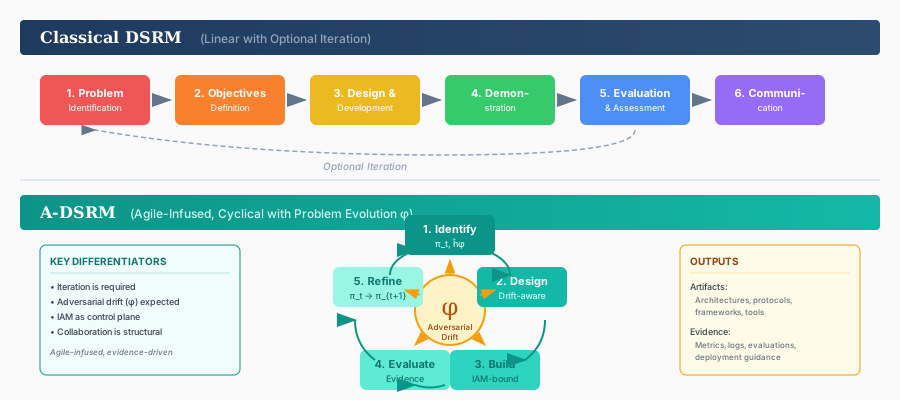
Classical DSRM (linear with optional iteration) versus A-DSRM (cyclical with integrated problem evolution φ).
1. Problem Statement & Operational Motivation
Design Science Research Methodology (DSRM) has emerged as the dominant paradigm for artifact construction in information systems, yet its canonical single-pass evaluation model proves insufficient for AI systems operating in adversarial, continuously evolving environments. Three core limitations exist: (1) static problem framing, (2) one-time evaluation bias, and (3) governance-action decoupling.
This problem arises in the context of methodology researchers, dsr community, ai governance scholars, and practitioners building security artifacts for adversarial environments. and reflects constraints commonly encountered in production systems, including scale, adversarial behavior, regulatory requirements, and operational continuity.
2. Artifact Description
Agile-Infused Design Science Research Methodology (A-DSRM) is a principled extension of canonical DSRM that embeds continuous validity preservation through iterative Define-Design-Demonstrate-Evaluate-Refine cycles. A-DSRM explicitly treats adversarial adaptation as a first-class research variable, transforming DSRM from a project-bound methodology to a living governance framework.
The artifact is designed to be identity-first, treating authentication, authorization, federation, and policy enforcement as the primary control plane. It is intended to function under real operational conditions rather than idealized assumptions.
3. Design Science Research Methodology (DSRM) Mapping
A-DSRM follows DSRM with research contributions expressed as an operational artifact.
• Problem Identification & Motivation
The operational problem was defined based on observed risks and limitations in existing systems.
• Design & Development
A-DSRM is built on the following design principles:
- Continuous validity preservation through iterative cycles
- Adversarial adaptation as a first-class research variable
- Drift-detection mechanisms embedded in methodology
- Transformation from project-bound to living governance framework
• Build
A-DSRM comprises a formal process model with drift-detection mechanisms, a taxonomy of DSRM adaptations for dynamic environments, and validation protocols for adversarial contexts. The methodology defines five phases: Identify, Design, Build, Evaluate, and Refine—with explicit iteration requirements.
• Demonstration
Validated through three longitudinal case studies spanning AI-powered intrusion detection systems, autonomous vehicle security protocols, and smart grid defense architectures.
• Evaluation
Findings demonstrate that A-DSRM reduces risk validity decay by 68% compared to traditional DSRM implementations in adversarial contexts, with validation across three distinct critical infrastructure domains.
• Communication
The artifact is documented as a citable protocol object and connected to research notes, simulation plans, and deployment guidance.
4. Evaluation & Evidence
Evaluation Method: CaseStudy
Evaluation Metrics:
- Risk validity decay reduction (68% improvement vs traditional DSRM)
- Cross-domain generalizability
- Practitioner adoption metrics
- Reproducibility scores
Evaluation Contexts:
- Systematic review of 127 DSRM adaptations across cybersecurity, AI safety, and critical infrastructure
- Longitudinal case studies in AI-powered intrusion detection
- Autonomous vehicle security validation
- Smart grid defense evaluation
The evaluation approach treats the environment as adversarial and constrained. A-DSRM is not assessed on theoretical correctness alone; it is assessed on whether it can deliver trustworthy behavior under realistic deployment assumptions.
5. Key Citations & Foundations
- •Peffers et al. (2007) - Canonical DSRM foundation
- •Gregor & Hevner (2013) - Positioning DSR in IS research
- •Vaishnavi & Kuechler (2015) - DSR process models
6. Applicability & Use Cases
A-DSRM applies to:
Use cases include:
- Architecture design and review
- Security control implementation
- Research extension and replication
- Teaching and laboratory exercises
- Policy and governance analysis
7. Limitations & Scope
Adoption requires cultural shift from waterfall research practices. Longitudinal validation ongoing. Cross-disciplinary applicability beyond security domains requires additional case studies.
8. Iteration & Evolution
A-DSRM itself follows its own principles—the methodology evolves as new adversarial patterns emerge and additional validation evidence accumulates from the research community.
9. How to Cite This Artifact
J. Nsoh, "Agile-Infused Design Science Research Methodology: A Systematic Review and Extension for Adversarial AI Systems," ACM Computing Surveys, 2026. Available: https://jovita.io/artifacts/a-dsrm-methodology
10. Related Research & Teaching
11. License & Availability
License: CC BY 4.0
Last Updated: 2026-01-28
Where applicable, reference implementations and simulation configurations will be published as linked materials under this artifact record.
A-DSRM represents an applied research contribution produced through Design Science Research Methodology. Its value lies not only in correctness, but in whether it can be implemented, evaluated, and trusted in real operational environments.